Connectivity that supports colocation, cloud, and distributed infrastructure

DartPoints helps organizations connect infrastructure across data centers, cloud platforms, carriers, partners, and business locations.

Our connectivity and interconnection options support local colocation, enterprise colocation, AI/GPU colocation, private cloud, hybrid cloud, disaster recovery, and multi-site environments. Whether you need network services, cloud connectivity, or peering, DartPoints can help you evaluate the right connection path for your workload.


Three Connectivity Paths

DartPoints supports three common connectivity needs: network services, private cloud connectivity, and peering. The right path depends on what you need to connect, how the traffic needs to move, and what matters most for performance, control, and reliability.
For organizations that need reliable network access, private connectivity, point-to-point options, and operational support across regional data center environments.
Best fit when you need to:
For organizations that need private, scalable access to cloud platforms and digital ecosystems from regional data center environments.
Best fit when you need to:
For networks, service providers, content providers, enterprises, and other organizations that need direct traffic exchange in regional markets. Bridge IX is DartPoints’ peering platform, providing access to regional internet exchange points where available.
Best fit when you need to:

Common Connectivity Use Cases

Connecting colocated infrastructure to users and sites
Extending a private network into a DartPoints data center
Connecting regional infrastructure to public cloud platforms
Supporting hybrid cloud and multi-cloud architectures
Building resilient network paths for critical applications
Improving traffic exchange through peering
Supporting disaster recovery and secondary site strategies
Connecting distributed regional operations

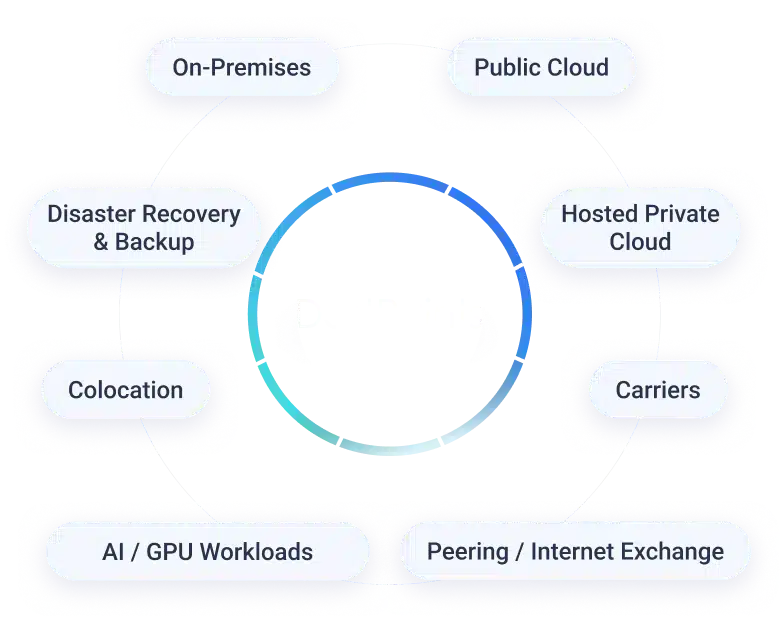
How Connectivity Brings Your Infrastructure Together

DartPoints connectivity options support the way infrastructure actually works across data centers, cloud environments, carriers, customer sites, and recovery environments.

Find the right connectivity path

Tell us what you’re trying to connect, where it needs to go, and what has to work well. We can help you sort through performance, reliability, control, and growth without overcomplicating it.

Frequently Asked Questions

Peering lets two networks exchange traffic directly instead of sending that traffic through a traditional transit provider. For the right organizations, that can mean a shorter path, more routing control, and better network performance.
With internet transit, one network pays another provider to carry traffic to the rest of the internet. Peering creates a direct exchange between participating networks, which can reduce reliance on traditional transit for certain traffic.
Peering is most useful when your organization exchanges enough traffic with other networks, cloud providers, content providers, or digital platforms to benefit from a more direct connection.
It can. A more direct traffic path may reduce the distance traffic travels, which can improve latency and application performance for certain traffic patterns.
Not usually. Peering is typically one part of a broader network strategy. Many organizations use peering alongside internet transit, private connectivity, and other network services.
Common participants include internet service providers, content delivery networks, cloud and hosting providers, enterprises with significant traffic needs, education and research networks, and other network operators.
Bridge IX, DartPoints’ peering platform, is available through internet exchange points in Dublin, Ohio and Baton Rouge, Louisiana, where approved and available.
Start with your traffic patterns, routing needs, current transit usage, latency requirements, and the networks you want to reach. DartPoints can help you determine whether peering would add value or whether another connectivity option is a better fit.
✕
Guidelines

File info
Format
File size
Resolution