Guidelines

The DartPoints Brand Kit provides everything you need to create consistent, on-brand communications.

Use these assets and guidelines to ensure clarity, cohesion, and accuracy across all digital and print materials.


Who we are

DartPoints

Key Messages

Supporting Themes

Brand Guideline

Logo

Colors

Typography

Visual Language

Images

Writing Guidelines

Essentials

Frequently Asked Punctuation Questions

How to create a post for DartPoints Blog

Result No Found

DartPoints

DartPoints is a leading provider of high-performance enterprise colocation, cloud, and managed service solutions, enabling advanced workloads including artificial intelligence, machine learning, and high-performance computing. Listed on the Inc. 5000 as one of the fastest-growing privately held companies in the U.S., DartPoints empowers businesses with enterprise-grade infrastructure, operational resilience, and low-latency connectivity.

50-words Boilerplate

DartPoints provides high-performance enterprise colocation, cloud, and managed services for advanced workloads including AI, machine learning, and HPC.

Key Messages

Vision

A world where high-performance infrastructure is accessible in every market – not just major metros.

Mission

To proactively expand high-performance infrastructure in underserved markets so demanding workloads can scale anywhere.

Supporting Themes

Keep Private Cloud Control Without Owning the Operational Burden

Many teams want private-cloud outcomes – control, stability, and resilience – without turning their staff into a permanent lifecycle and upgrade machine. DartPoints provides a dedicated, managed private hosted cloud on Nutanix with a clear migration plan and standardized operations, so teams can modernize without rewriting applications or getting stuck in a cycle of upgrades, patching, and lifecycle management.

Scale Without Redesigning Your Infrastructure

Enterprise teams have often squeezed a lot out of what they have. The challenge is that the bar keeps rising, with more load, higher uptime expectations, tighter maintenance windows, and increasing pressure to reduce risk. DartPoints delivers a modern 20 to 500kW colocation foundation with real power headroom and network options so organizations can scale cleanly without rearchitecting your environment.

Regional High-Density Infrastructure for AI and HPC

You don’t need a hyperscale answer for every growing workload. What matters is density, speed to usable capacity, and a clean expansion path. For inference AI and high-performance workloads that need to sit closer to users and data, DartPoints delivers contiguous high-density capacity in regional markets with available power availability and a defined growth path.

Logo

Primary Logo

Our main visual identifier. Use this version in most applications.
Primary logo over light background 
Single color logo
Single color logo

Clear Space

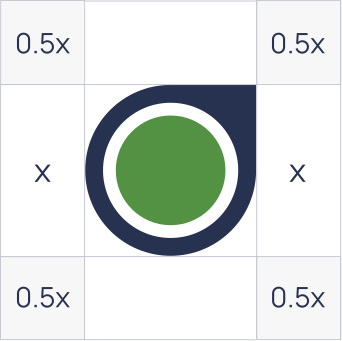
To maintain the integrity and visibility of the DartPoints logo, always surround it with sufficient clear space. This protected area prevents other graphic elements, text, or imagery from crowding or competing with the logo.

Clear space ensures the DartPoints brand remains recognizable and readable in all applications.
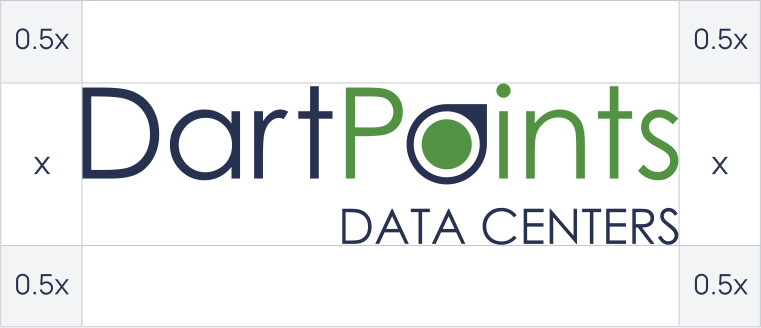
Logo Safe zone
Logomark safe zone

Minimum sizes

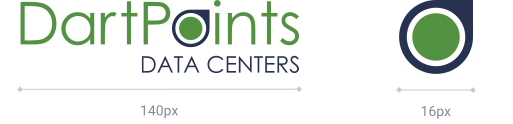
For readability, scale needs to have special considerations. Do not reduce these elements below these designated sizes.

Print
Never use the logo smaller than 25mm in width
Digital
Never use the logo smaller than 75px in width
Logo Misuse

To maintain consistency with our brand, the logo should only ever be used as described in the guidelines. The examples here show some misuses of the logo that should be avoided.
Never stretch the logo
Never rotate our logo
Never apply effects to the logo
Never mix colors from the palette 
Never place on busy or high-contrast backgrounds

Co-branding Overview

This section provides guidance for DartPoints partners to ensure that all marketing materials remain aligned with the DartPoints brand standards.

Creative assets appropriate for co-branding include:

  • Email headers
  • Product or service collateral
  • Event signage and online event landing pages

Materials containing DartPoints intellectual property—such as proprietary white papers, technical documentation, or content featuring DartPoints-specific text or imagery—are not suitable for co-branding.

Any asset that includes DartPoints-created content must be reviewed and approved by the DartPoints marketing team at [email protected] prior to use.

Co-branded Logo Lockups

Partner Dominant Co-branding

If a partner develops a DartPoints-themed program to take to market or launches a brand awareness campaign, the partner’s brand should take the lead, using a lockup that places the partner’s logo first, followed by the DartPoints logo.

At the same time, it is essential that the DartPoints logo is displayed correctly and in accordance with these guidelines. All partner-created program logos or lockups must be reviewed and approved by the DartPoints Marketing team prior to use.

Dartpoints Dominant Co-branding

DartPoints-dominant communications refer to materials where the DartPoints brand leads the customer experience, and the design relies heavily on the DartPoints visual system.

If you are promoting a DartPoints product or solution, please use the lockup that places the DartPoints logo before your company’s logo.

Colors

Primary Colors

DartPoints’ primary colors define the brand’s core identity. They should be used consistently across all touchpoints to maintain a unified and recognizable presence.

Secondary

The secondary colors complement the primary palette and help establish visual hierarchy and differentiation. The supporting secondary colors should be used for backgrounds, charts and diagrams, and iconography.

Typography

Primary Typeface — Roboto

Roboto is the primary typeface for DartPoints. It should be used across all brand communications, including digital, print, marketing materials, and documentation.

Roboto is an open-source typeface that performs consistently across web and print environments. It offers a wide range of weights, allowing flexibility while maintaining clarity and hierarchy.

When Roboto is unavailable, Arial serves as the approved system fallback typeface.

Roboto

Aa

ABCDEFGHIJKLMNOPQRSTUVWXYZ
abcdefghijklmnopqrstuvwxyz
1234567890(,.;:?!$&*)

Aa

ABCDEFGHIJKLMNOPQRSTUVWXYZ
abcdefghijklmnopqrstuvwxyz
1234567890(,.;:?!$&*)

Aa

ABCDEFGHIJKLMNOPQRSTUVWXYZ
abcdefghijklmnopqrstuvwxyz
1234567890(,.;:?!$&*)

Aa

ABCDEFGHIJKLMNOPQRSTUVWXYZ
abcdefghijklmnopqrstuvwxyz
1234567890(,.;:?!$&*)

Aa

ABCDEFGHIJKLMNOPQRSTUVWXYZ
abcdefghijklmnopqrstuvwxyz
1234567890(,.;:?!$&*)

Aa

ABCDEFGHIJKLMNOPQRSTUVWXYZ
abcdefghijklmnopqrstuvwxyz
1234567890(,.;:?!$&*)

Aa

ABCDEFGHIJKLMNOPQRSTUVWXYZ
abcdefghijklmnopqrstuvwxyz
1234567890(,.;:?!$&*)

Aa

ABCDEFGHIJKLMNOPQRSTUVWXYZ
abcdefghijklmnopqrstuvwxyz
1234567890(,.;:?!$&*)

Aa

ABCDEFGHIJKLMNOPQRSTUVWXYZ
abcdefghijklmnopqrstuvwxyz
1234567890(,.;:?!$&*)

Aa

ABCDEFGHIJKLMNOPQRSTUVWXYZ
abcdefghijklmnopqrstuvwxyz
1234567890(,.;:?!$&*)

Usage

HTML


CSS

				
					font-family: "Roboto", sans-serif;


Presentation Typeface — Oswald

For presentation materials, Oswald is designated for headings and emphasis.

Oswald adds visual strength and impact when used sparingly. It should not replace Roboto for body copy or extended text.

OSWALD

Aa

ABCDEFGHIJKLMNOPQRSTUVWXYZ
abcdefghijklmnopqrstuvwxyz
1234567890(,.;:?!$&*)

Aa

ABCDEFGHIJKLMNOPQRSTUVWXYZ
abcdefghijklmnopqrstuvwxyz
1234567890(,.;:?!$&*)

Aa

ABCDEFGHIJKLMNOPQRSTUVWXYZ
abcdefghijklmnopqrstuvwxyz
1234567890(,.;:?!$&*)

Aa

ABCDEFGHIJKLMNOPQRSTUVWXYZ
abcdefghijklmnopqrstuvwxyz
1234567890(,.;:?!$&*)

Aa

ABCDEFGHIJKLMNOPQRSTUVWXYZ
abcdefghijklmnopqrstuvwxyz
1234567890(,.;:?!$&*)

Images

Use images of Datacenter/ Server Racks/ with slight blur in the background and more focused on the object in foreground. The color and mood should be dramatic when selecting images and should align with the core brand colors.

All the images should be of high quality and not pixelated.

For industry specific images, use images with clean and clear focus on the subject. Avoid using busy looking or images with too many people in it.


For abstract and visualized images, use images with depth and slight blur in the background. It is recommended to select images with minimal clutter and that have colors more aligned with DartPoints’s branding.

Essentials

Voice

Write like an infrastructure operator: clear, calm, confident. Plain language over hype. Avoid buzzwords and vague superlatives.

Voice test
  • Should sound like a seasoned infrastructure operator who knows exactly what they are doing.
  • Should not sound like a startup trying to sound bold.

Buyer-first outcomes

Lead with what buyers care about: capacity, uptime, resiliency, speed to deploy, predictability, proximity to users and data.

Example:
  • Instead of: Transform your infrastructure journey
  • Say: Scale capacity without rearchitecting your environment.

Claims discipline

No “best in class,” “world class,” “future-proof,” “unlimited.”

Use measurable or defensible phrasing: “defined expansion path,” “deployment-ready capacity,” “available power capacity” (only if true and supportable).

Terminology (use consistently)

Prefer:

demanding applications, high-density capacity, private hosted cloud, enterprise colocation, regional markets, power headroom, low-latency connectivity.

Avoid:

“edge provider” (unless you define it once, clearly).

Numbers and units

  • Use 20 to 500kW in body copy; 20–500kW is fine in headings if design prefers.
  • Use 500kW+ where helpful.
  • Be consistent with spacing and capitalization (kW, MW).

Punctuation and readability

  • UNo em dashes.
  • Short paragraphs, active voice.
  • Prefer periods over semicolons.

Differentiation check

Every page should reinforce at least one: enterprise-grade, regional/underserved markets, proactive expansion, high-density readiness, operational accountability.

If a paragraph could fit any colo provider, rewrite it.

Audience specificity

For press and website top-level: “applications,” “infrastructure,” “capacity.” 

For technical pages:
“workloads,” “density,” “GPU,” “HPC,” “inference,” as appropriate. 

Frequently Asked Punctuation Questions

How do you write “DartPoints?”
Capital ‘D’ and capital ‘P’ with no spacing in between, all one word: DartPoints
How do we use em dash?
  • No em dashes.
Capitalization in titles and subheads
  • All Caps for all titles except for the blogs.
  • Use Title case for the blog titles.
  • Sentence case for email subject lines
Hyphenate usage
  • cost-efficient
  • performance-driven

How to create a post for DartPoints Blog

To maintain quality, clarity, and strategic alignment across the DartPoints Blog, please follow the process below before submitting any content.
Ask yourself:
  • Who is the target audience for this post?
 (e.g., IT leaders, infrastructure teams, enterprise decision-makers, partners)
  • What problem does this post address?
  • How does it provide value to our audience?
  • Does the topic align with DartPoints’ core focus areas, including managed IT services, network support, cloud services, cybersecurity, automation, and optimization?
  • If the topic does not directly support our strategic themes or business objectives, it may not be suitable for publication.
All blog ideas must be reviewed before drafting begins.
  • Share your proposed topic with the Marketing Team.
  • Once approved, create a structured outline that includes:
  • Proposed working title
  • Introduction (problem or context)
  • Key sections or arguments
  • Conclusion
  • Clear call-to-action (e.g., contact us, download resource, request consultation)
  • Share the outline in a Google Doc for review and feedback before writing the full draft.
Guidelines

File info
Format
File size
Resolution